

Alternative Financing Models Emerge To Offset Rising Computation Costs
Compute is no longer a line item. It constrains delivery and shapes financing. Vendors offer token credits today in exchange for a claim on future revenue. It buys speed now, and reduces margin later. Model the downside before signing.

What Investors Are Really Funding When They Back a Deep Tech Spinout
University labs produce credible deep tech, and global investors fund the execution that follows. For climate hardware, where timelines run long and proof costs real money, capital tends to back the next 18 to 24 months of work. This playbook covers what to show at each stage, and what cross-border diligence tests.

Who Controls the Data Behind Europe's Climate Rules
Europe writes the climate rules but rents the data and models that make them enforceable. Most ESG data used in the EU sits with non-EU actors. That concentration is a continuity risk, and it should shape how ministries write their next procurement contract.
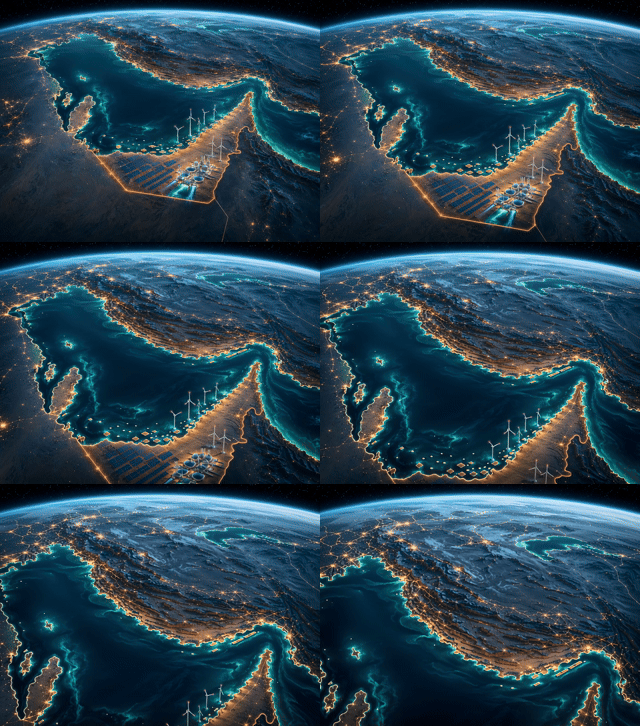
What Is Happening To Climate Tech In The UAE?
The Iran war closed the Strait of Hormuz and hit UAE markets hard, yet climate regulation held and sovereign climate capital kept deploying. For founders and investors watching the UAE, the past quarter was a live stress test, and the results reshape the market-entry case.

Why Climate Tech Expansion Now Lives or Dies on Local Politics
Climate tech expansion now hinges on local political economy, not market size. Fragmented rules, permitting gates and infrastructure constraints decide timelines and costs. Map each market's hard gates, model physical constraints early, and sequence compliance against commercial traction to manage volatility.

Calculating the Trade-Offs Between Renewable Infrastructure and Direct Air Capture
Renewables versus Direct Air Capture is rarely binary. It is a sequencing decision shaped by clean power, timelines and capital. Build renewables now, expand DAC capacity early for residuals, and design pilots around contracts and measured performance, not algorithms.

Open-Source Evaluation Frameworks for Asset-Level Industrial Transition Planning
Asset-level data is replacing group-level targets as the credibility standard for industrial net-zero plans. Open-source frameworks let startups, investors, and operators test whether capex schedules match transition commitments, facility by facility, before lenders and regulators do it for them.

Navigating Enterprise Hardware Constraints in Commercial Software Deployments
Enterprise software deployments in climate tech are stalling on hardware, not model quality. Compute capacity is now a procurement variable, affecting SLAs, contracting, and go-live timelines. Hardware lead times, memory shortages, and reserved capacity premiums require explicit planning from the earliest stages of an enterprise sales cycle.

Climate Risk is Moving from Scenario Planning to Legal Spend
Climate attribution science is turning corporate emissions data into courtroom evidence. As public data systems weaken and event-linked lawsuits grow, companies face immediate legal costs tied to specific sites. Good data governance is now a legal defence, not just a reporting obligation.

Attracting Private Wealth to Climate Adaptation Infrastructure
Private wealth does not need perfect certainty on climate adaptation. It needs a clear counterparty, a defined contract, and reporting it can defend to an investment committee. For founders, that starts with one question: what is the payer buying?

Training Custom Algorithmic Models on Proprietary Industrial Data
Most industrial AI pilots fail because generic models never learned the specifics of the plant they were deployed into. The fastest path from pilot to production is custom machine learning trained on proprietary data that captures site physics, control logic, and operating routines.

When Compute Meets Capacity: The Grid Constraints Reshaping Tech Sovereignty
AI data centres can move from site control to procurement in months. Grids cannot. Substations, transformers, and transmission upgrades take years. That timing gap is now the central policy problem for every government pursuing domestic compute as a matter of national security.
Designing for Disruption: Decentralized Energy as a Supply Chain Defense
Decentralised energy is emerging as critical infrastructure for supply chain resilience. Microgrids, storage, and fuel flexibility can protect operations during disruption, yet financing, design discipline, and procurement complexity continue to limit deployment at scale across industrial systems.

Orbiting Data Centres: Are They Pie In The Sky For Climate Start-ups?
Orbital data centres promise solar-powered compute and in-orbit data processing. Yet launch constraints, carbon costs, and limited access mean the idea remains experimental. For climate tech founders today, space-based computing offers intriguing possibilities, but still faces major technical and economic barriers.

The New Kingmakers: How Corporate Giants Are Reshaping the Climate Tech Cap Table
Corporate giants are reshaping climate tech cap tables, bundling capital with infrastructure, procurement access, and market reach. This founder playbook explains how to leverage strategic money and CVC without losing control, optionality, or your go-to-market independence.

The VC Pivot: Why Crypto Capital Is Seeking Refuge in Real-World Climate Assets
Capital is rotating from token narratives toward governable, cash-yielding real-world assets. For climate innovators, that creates an opening. Structure, verification and enforceable rights now matter more than liquidity, offering a pathway to institutional capital without becoming a crypto company

Managing the Fatigue of Long-Term Decarbonization
In year two or three of decarbonisation, dashboards may improve but business as usual still dominates. Fatigue stems from fragmented data, unclear decision rights and procurement friction. Closing the implementation gap demands process redesign, embedded standards and disciplined operating metrics.

Beyond SaaS: Why 'Scientific Superintelligence' is the Next Billion-Dollar Thesis for Climate Tech Investors
Climate tech investment is shifting from incremental SaaS towards AI-driven scientific discovery. Scientific superintelligence is accelerating breakthroughs in decarbonisation, green hydrogen, and carbon capture, reshaping how investors drive scalable climate impact across global markets.

The Dubai Convergence: What Founders Need to Know About MENA's New Innovation Triangle
Scaling in MENA demands more than fundraising trips to Dubai. Founders must align with the region’s infrastructure boom, embedded climate regulation and fast-moving digital systems. Success comes from pilots tied to real assets, local partnerships, and capital strategies built for long-cycle projects, not quick wins.

A Pragmatic Guide to Achieving Europe's 2040 Climate Goals
A pragmatic analysis of Europe’s 2040 climate goal, examining policy realism, investment gaps, industrial trade-offs and political constraints. We argue credible delivery depends on technology diversity, capital mobilisation and honest timelines, rather than just target setting or over-reliance on electrification.